These 3 successes have something in common - The benefit and impact of taking a SYSTEM-WIDE view to get focused.
System-Wide View for Bigger Impact
Pam Vecellio • October 7, 2026
System-Wide View for Bigger Impact

A TEAM WORKED HARD AND GOT NOWHERE.
A field inspection team wanted to visit more customers each day to
increase capacity. They improved their on-site inspection processes and customers noticed the better quality. But their daily visits did not change. When they mapped the whole process, in their 2nd improvement effort, the real barrier jumped out: they spent more time driving between customers than with them. Better scheduling fixed it, and visits per day finally went up.
This is System-Wide Impact. Before dropping into detailed fixes, step back and look at the whole system. The root cause of a gap often occurs upstream of where the gap is detected.
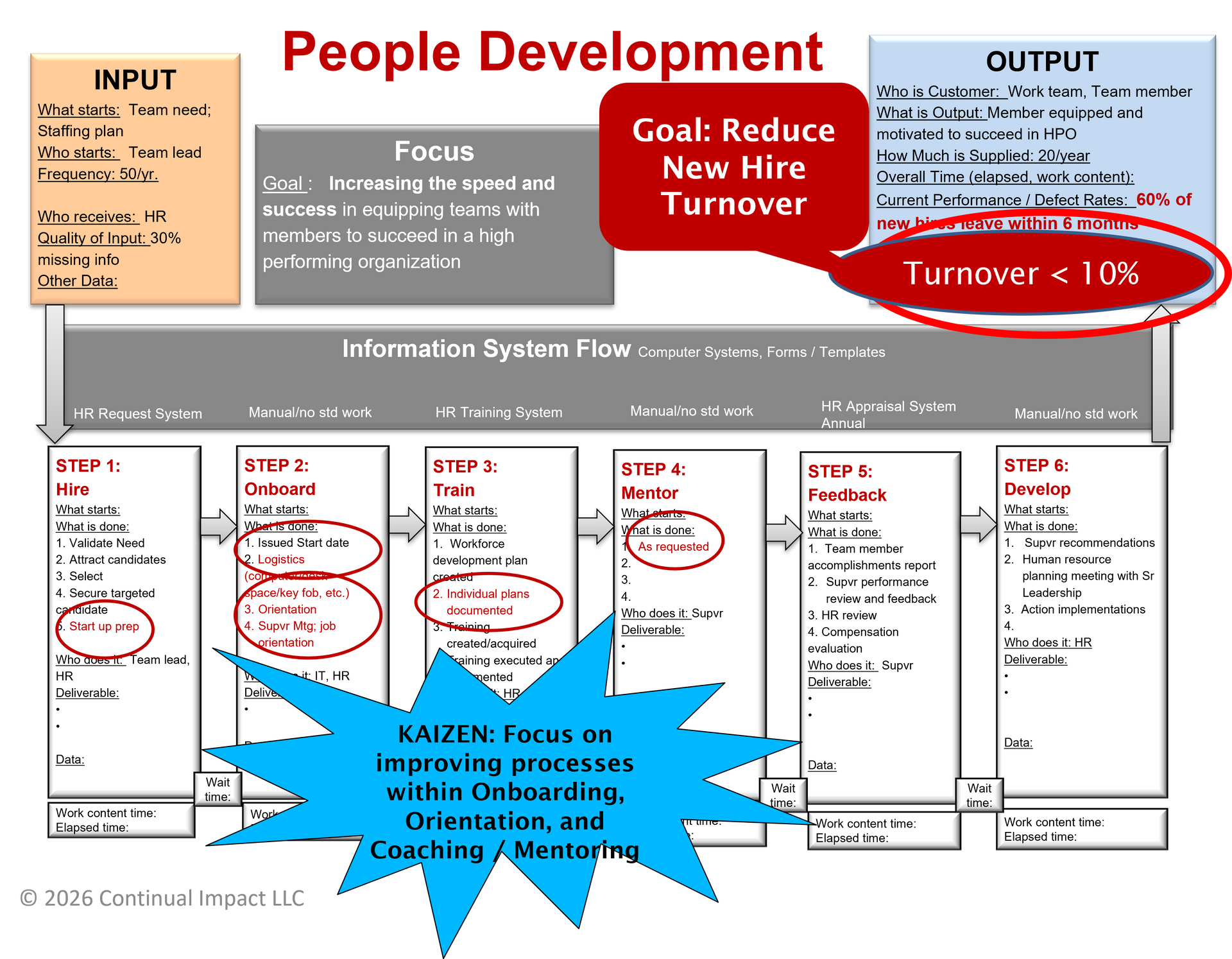
A team knew they had a problem yet did not know where to begin...a SYSTEM-WIDE view provided the focus.
The organization's employee turnover rate was high. A team was convened to fix this. Turnover data led the team to new hires (60% of new hires left within 6 months). Now what?! They had ideas with little confidence they would fix the problem. The project leader tried a system-wide view using a value stream map. This high-level system-wide map helped the team see where the problems began and where they could have the biggest impact. See the value stream map below, which shows where they focused their problem-solving efforts.
Their results: Turnover rates decreased from 60% to <10% and they saved $500K-$1M per year in lower costs (recruiting, interviewing, on-boarding, and overtime to fill empty positions).
Another team began with a SYSTEM-WIDE view to guide their plans and impact.
They wanted to add a team member. When the gathered data, they found 90% of their suppliers' input was incorrect or incomplete. By fixing the input together with the suppliers, defects dropped from 90% to 10% in one month, supplier relations improved, and the new hire was no longer needed.
Tools like Value Stream Maps and SIPOC (Supplier, Input, Process, Output, Customer) provide the structure for a system-wide view.
Using these steps keeps the focus on what is most impactful. As a result:
- Leaders agree on and communicate what we do well and where to focus performance improvement efforts.
- Performance improvements across the system; no sub-optimization in one silo, department, or team.
- Resources are aligned to improve the greater good. More buy-in!
- We stop chasing the gaps and problems because we know where they begin and where they are discovered.
- Gain more impact, faster, and with less effort.
Join In: Take a System-Wide View for Bigger Impact
- Agree on the goal, objectives, and needed outcomes.
- Frame the system view:
- a. What starts this system (input)
- b. What ends this system (output)
- Identify the big 'buckets' between the start and end.
- Fill in the data: what is done, by whom, deliverables, systems used, time, and quality.
- Step back and view the entire system to see the biggest gaps and improvement opportunities.
- Agree on the priorities to resource, then use improvement methods to close these gaps quickly and effectively.
We’ve seen SYSTEM-WIDE tools and views transform organizations and teams of all sizes and industries.
Join in to increase your impact - gain the knowledge, skills, and templates with our System-Wide Focus training, or let's partner and do the first map together.