Building Stronger Supervisors and Team Leaders: Training Within Industry Training
Building Stronger Supervisors and Team Leaders: Training Within Industry Training
Helping supervisors gain the skills, confidence, and tools to lead people, improve work, and deliver results.
This very practical, results‑driven training builds the capabilities of new and emerging leaders to lead teams to higher performance. Our approach blends Training Within Industry training with new learnings, hands‑on applications, and proven improvement methods.
Goal of Training: Increase the knowledge, skills, and confidence of supervisors and team leaders through training and immediate job-related application.
Benefits of Training:
- Clear, structured job aids and methods that are easy to learn and apply.
- Hands‑on practice that creates immediate and visible benefits.
- A shift from managing tasks to leading people.
- A better work environment, engagement, communication, and ownership.
- Teams working more safely, efficiently, and confidently.
Agenda:
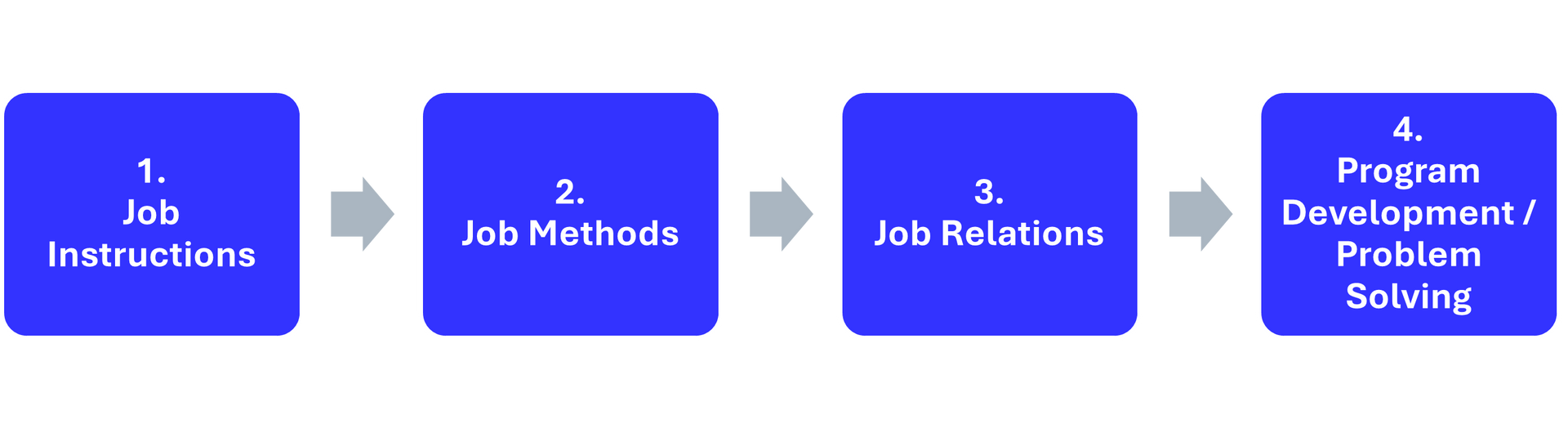
JOB INSTRUCTIONS (JI)
Participants learn how to break down jobs, prepare training plans, and deliver instruction that accelerates learning and reduces errors.
Learning Modules:
- Current supervisor performance and gaps
- Building role profiles
- Active listening & communicating
- Teaching others
- Assigning tasks; Managing and prioritizing my time
- Providing feedback & escalation when performance is below expectations
Hours: 12
Outcomes: Faster onboarding, less turnover, fewer errors, stronger standard work, reduced variations.
JOB METHODS (JM)
A systematic approach to improving how work is done. Participants learn to analyze tasks and redesign methods to increase productivity without sacrificing quality or time.
Learning Modules:
- Creating system-wide focus
- Mapping work processes to understand, get aligned, and improve
- Documenting standard work instructions (aka standard operating procedures)
Hours: 8
Outcomes: Higher efficiency, simplified workflows, measurable performance gains.
JOB RELATIONS (JR)
Participants learn how to build stronger and more productive workplace relationships. JR equips leaders with skills to create an environment where people feel respected, engaged, and able to perform at their best.
Learning Modules:
- Foundations of good relations
- The importance and potential of people
- Team model; Evaluating my team
- Motivating & engaging people
- Decision Making; Change / Communication
- Mitigating problematic behaviors
- Establishing and leading team huddles
Hours: 14
Outcomes: Improved morale, higher engagement, reduced conflict, better team performance.
JOB PROGRAM DEVELOPMENT (PD) / PROBLEM SOLVING (PS)
This module equips participants with practical problem-solving skills to identify, analyze, and resolve workplace challenges and wastes effectively. Participants learn structured approaches to greater focus, root cause analysis, and continuous improvement.
Learning Modules:
- Getting focused with a goal statement
- Identifying and using performance measures
- Solving problems and improving work processes
- Effective implementation
- Lessons Learned
Hours: 8
Outcomes: Enhanced problem-solving capability, faster issue resolution, and sustained operational improvements.
*The Training Within Industry (TWI) service was created by the United States Department of War, running from 1940 to 1945 within the War Manpower Commission. The purpose was to provide consulting services to war-related industries whose personnel were being conscripted into the US Army at the same time the War Department was issuing orders for additional material. It was apparent that the shortage of trained and skilled personnel at precisely the time they were needed most would impose a hardship on those industries, and that only improved methods of job training would address the shortfall. By the end of World War II, over 1.6 million workers in over 16,500 plants had received a certification. The program continued post-war in Europe and Asia, where it aided reconstruction. It is most notable in the business world for inspiring the concept of kaizen in Japan. In addition, the program became the foundation of the Toyota Production System and the DoD resourced open source Management System (3.1).
From Wikipedia, the free encyclopedia