Value Engineering and Design For Excellence
Value Engineering (VE) and Design for Excellence (Df(X))
Value Engr = every product component must bring value.
Df(x) = the product is designed with purpose and desired outcome.
Goal:
To develop knowledge and skills of the Value Engineering and Design for Excellence methods and be able to critically analyze the value of every item’s component, AND decrease item, processing, operating costs. The team will use the analysis to identify component and assembly design changes that significantly reduces item costs + process times and quality.
Benefits:
- Better designed items.
- Items and processes are performed with less cost, time, and higher quality.
- Reduced operating costs.
- Increased margin and profitability of products.
- Increased pride and ownership of improved products.
- Engage team members in improving the process, product, or service. Increased pride and ownership of improved products.
Value Engineering
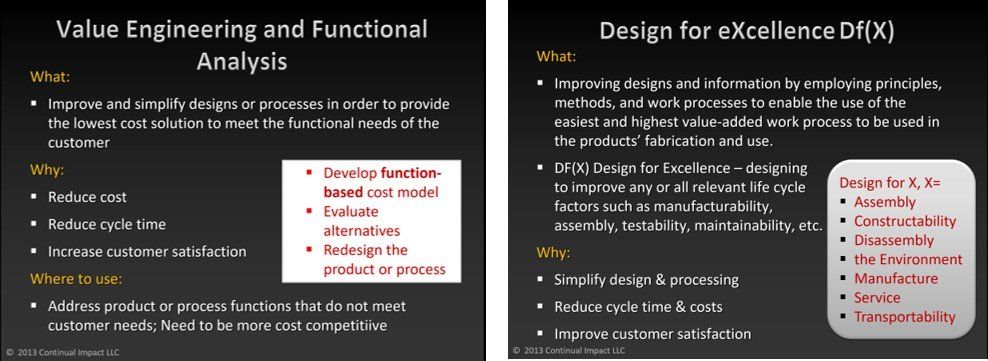
Objective: To develop knowledge and skills of the Value Engineering method and be able to critically analyze the value of every item’s component, decrease item, processing, and operating costs. The team will use the analysis to identify component and assembly design changes that significantly reduces item costs.
Benefits: Better designed items. ∆ Items and processes are performed with less cost, time, and higher quality. ∆ Reduced operating costs. ∆ Increased margin and profitability of products. ∆ Increased pride and ownership of improved products.
Leading a team through the Value Engineering process.
- Participants bring a product or process on which to improve.
- Confirming and Preparing the team.
- Facilitating the process.
- Gathering and analyzing current state data (customer, regulatory, costs and processes (procure, fabricate, assemble, inspect, rework, ship, warranty)).
- Performing the functional analysis.
- Identifying alternative ways to satisfy functions.
- Prioritizing, selecting, testing, and implementing improvements.
Design for Excellence
Objective: To develop knowledge and skills of the Design for Excellence method and be able to critically redesign a process or product to deliver a specific type of outcome.
Benefits: Designing products to improve any or all relevant life cycle factors such as manufacturability, assemble-ability, reliability, maintainability, testability, affordability, etc. ∆ Simply design and processing ∆ Reduce cycle times ∆ Decrease handoff errors ∆ Reduce costs ∆ Happy customers!
Leading a team through the Design for Excellence process.
- Participants bring a product or process to class on which to focus improvement.
- Identify the area/part/assembly to be improved and life cycle factor(s) aka define the “x” (construct, assemble, dissemble, environment impact, service, transport, etc.).
- Convene a cross-functional team.
- Establish goal and measures.
- Breakdown and document the current cost.
- Develop a set of design principles / functional requirements.
- Decide on priority solutions.
- Design, document, test, and implement improvements.
Application and Coaching: On-site event co-lead. One-on-one coaching until results are achieved.
Certification: Participation in this course and completion of 1 project = Continuous Improvement VE or Df(x) Belt Certification.